
From Brief to Approved Sample: The Step-by-Step Process for a Spa Line
The path from a brief to an approved fragrance sample is seven decisions long, and it can be completed by a first-time spa buyer without any chemistry training. The sequence is the same whether the project is a single signature scent or a three-format amenity programme: requirement, feasibility, accord, evaluation, compliance, reference, and disciplined iteration. The buyer's job at each step is a choice, not a formula. This is the step-by-step process worth walking through before you spend anything.
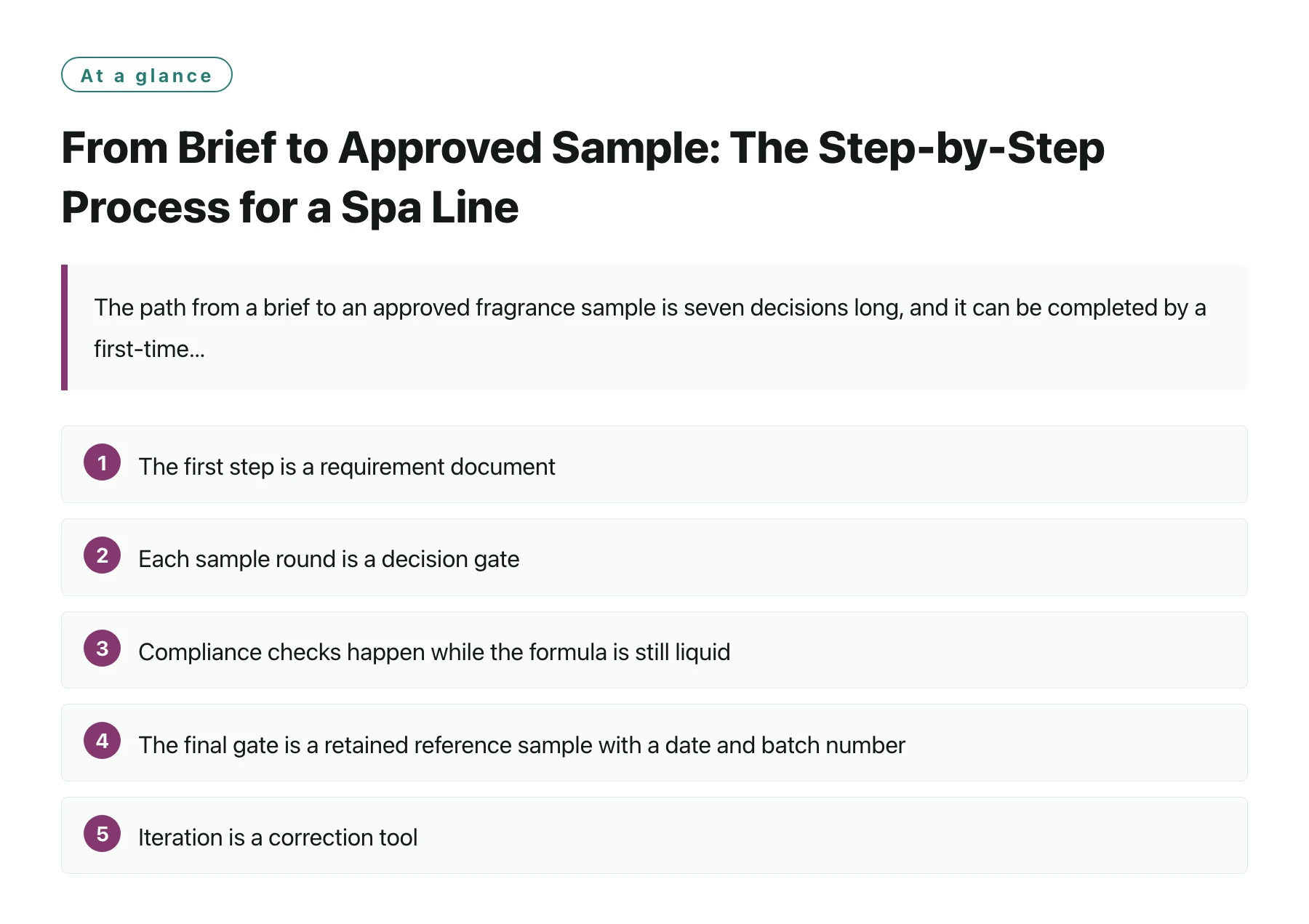
Key takeawaysThe first step is a requirement document, not a scent description: formats, intensity, markets and performance windows come before any adjectives. · Each sample round is a decision gate, and the gate only closes when one named person signs it against a written change request. · Compliance checks happen while the formula is still liquid, so the destination markets must be in the brief from day one. · The final gate is a retained reference sample with a date and batch number, which is the product the factory must reproduce at volume. · Iteration is a correction tool, not a design tool: rounds should make the scent match the brief, not chase a moving impression.
Spa buyers often assume that developing a fragrance requires them to speak perfumer. It does not. The process is designed so that the buyer contributes decisions — which markets, which format, which intensity — while the manufacturer contributes the chemistry.
What follows is the sequence, in the order it runs, with what the buyer needs to decide at each gate.
The seven gates of sample approval
- Write the requirement, not the scentState the formats, the markets, the intensity in the room, the performance window and the budget bandwidth. Adjectives are welcome later; the requirement is what the factory can work from.
- Send the brief for a feasibility readA serious manufacturer answers three questions in writing: what is achievable, what is restricted, and what will cost more than the buyer expects. This read is the first test of the supplier, and it is free information.
- Receive the first accordThe perfumer returns a first trial built against the requirement, usually as a concentrate and a diluted evaluation sample. Judge it against the brief, not against a dream you have not described.
- Evaluate it properlySmell it on the surfaces the product will touch — linen, towels, conditioned room air, skin for personal care — and read it at intervals across a full day. One person signs the evaluation note.
- Run the compliance checkThe formula must be verified against every destination market before it is frozen; in the EU, CosIng is the reference database for checking ingredients against the rules [1]. The supplier runs this check; the buyer states the markets.
- Lock the reference and the tolerancesA sealed sample from the approved batch, dated and numbered, becomes the reference. The tolerances — colour, odour, fill weight — are written beside it, so the bulk run has a target and a boundary.
- Iterate only what is brokenIf a round misses, request exactly one written change per round and re-evaluate twice on separate days. The scent that needs no round is not a lost opportunity; it is the cheapest possible outcome.
What the process does not assume
None of these steps require chemistry knowledge, which is the point. A first-time buyer can run the whole sequence with a plain-language brief, because the heavy technical work happens on the manufacturer's side of each gate; a project briefed as a Xuelei custom perfume engagement, for instance, starts exactly where your requirement ends.
The sequence also looks almost identical across engagement models. their OEM/ODM manufacturing services differ mainly in who owns the formulation — your perfumer under OEM, the factory's perfumers under ODM — never in whether the sample gets evaluated, checked, locked and referenced. The seven gates are the part of the process that belongs to the buyer either way.
There is one more thing the process does not assume: that the same person will still be running the project in six months. Hotel and spa procurement teams turn over, and the written gates are what survive the turnover. When the original buyer leaves, the brief, the change log and the retained reference walk the new colleague through the entire history — which is the quietest benefit of doing the paperwork at each gate instead of at the end.
Where first-timers trip
The most common trip is skipping the feasibility read because it feels like a formality. It is not: this is where a manufacturer tells you, in writing, that the group of naturals you wanted is restricted, or that three formats cannot share one scent without compromise. Hearing that in week one costs nothing; hearing it in week six costs a round.
The second most common trip is approving against a refreshed impression. Between two rounds, evaluate both versions side by side, blind, on the same morning. The difference between iteration and churn is exactly this habit: iteration moves the scent toward the brief, while churn moves it toward whoever smelt the last sample.
A close third is comparing the sample to a famous commercial scent. “Make it smell more like the well-known brand we admired” is a request the factory cannot honour cleanly, for reasons of imitation and ownership, and it usually derails a perfectly good accord. The honest test is not “does it remind me of something familiar” but “does it do the job the brief described” — which is the only job the factory was asked to do.
Print the seven gates and hand them to the supplier on the first call. A manufacturer that respects the list will run the project faster than you expect; one that waves it away is telling you, early and cheaply, how your money will be spent.
Sources
- EU CosIng — Cosmetic Ingredient Database (European Commission) —— The European Commission's CosIng database of cosmetic ingredients, listing ingredient functions, restrictions and labelling requirements under EU cosmetics law.
Frequently asked questions
How long should each sample round take?
The time varies with the brief, the materials and the evaluation schedule, but the structure matters more than the calendar: each round needs a written change request, an evaluation protocol and a single sign-off. A project that has those moves faster than one that argues about them.
Can I skip the compliance check until production?
No. If a restricted ingredient is discovered after the formula is frozen, the redevelopment starts from the accord stage. Stating the destination markets in the brief and running the check at the sample stage is dramatically cheaper.
Do I need a perfumer on my side for an ODM project?
Not for the process itself. Under ODM the factory's perfumers develop the scent from your requirement, and your job is to evaluate and decide. A consultant is useful for strategy, not required for the seven gates.
What if I do not like the first accord?
That is what rounds are for. Write the change as one sentence — what to move, what to keep — and request the next trial. Most projects settle within two to four rounds when each round is a precise instruction.
Is the retained reference sample really the final product?
It is the specification the factory must match. The bulk run is tested against it — colour, odour, performance — so choosing it carefully and documenting it properly is the single most valuable decision a first-time buyer makes.
Stop guessing. Start training like a ranked fighter.
Working fighters, prospects, and coaches use Keith's systems to cut camp planning in half and step into the cage prepared.
Book a Fight-Camp Consult